
Guide · for guests and guides
How a thermal night drive works.
A thermal camera sees heat instead of light. On a thermal night drive your guide works the camera, and its live picture plays on tablets in the vehicle, so everyone watches the same animal in the dark. Here is what that means in practice, and what you can realistically expect.

Heat, not light
Everything gives off infrared radiation, and warmer things give off more. A thermal camera measures those differences and turns them into a picture. Because it doesn’t rely on visible light, it works in full darkness.
On a night drive that matters because animals are almost always warmer than what surrounds them. A body stands out against cooling grass, rock and water, even when it’s behind thin cover or far beyond the reach of a torch.
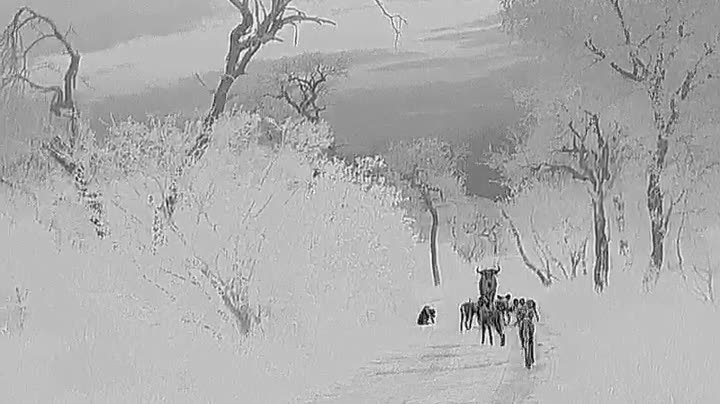
What the camera cannot do is show colour. You see shape, movement and temperature differences, and often surprising detail: skin texture, a tail flicking, the vessels in an elephant’s ear.
Reading the picture


On the vehicle
- Guide
Finds the heat
The guide works the thermal camera, scanning the bush for anything warmer than its surroundings.
- Tablets
Shares the view
The camera’s live picture plays on tablets in every row, so nobody has to pass a device around or lean over the front seat.
- Guests
Watch it happen
Everyone follows the same sighting while the guide explains what the animal is doing.
What to realistically expect
Sightings aren’t guaranteed. Thermal imaging helps a guide find animals in the dark. It can’t put them there. Some nights are busy, some are quiet.
You watch a screen, then the bush. Much of the viewing happens on the tablet. The picture is live, and you’re still out in the open vehicle hearing and smelling the night.
Contrast changes through the night. The camera sees temperature differences. Contrast is often strongest once the ground has cooled after sunset.
It’s a different kind of detail. No colour or eyeshine, but movement, posture and body heat you would never see by spotlight.
Common questions
What is a thermal safari?
A game drive, usually after dark, where the guide uses a thermal imaging camera to find and show animals by their body heat. With Thermal Safaris, the live picture plays on tablets in every row of the vehicle.
Is thermal the same as night vision?
No. Night vision amplifies small amounts of visible or near-infrared light. Thermal imaging measures heat, so it doesn’t need any light at all.
Can you see through bushes with thermal?
Not through solid cover. Heat can show through gaps in thin vegetation, which is why a thermal camera often reveals an animal the eye would miss, but dense bush or a tree trunk still blocks the view.
Why is the footage black and white?
Thermal cameras measure temperature, not colour. They can display it in greyscale or false-colour palettes. The footage on this site is shown as recorded, in greyscale.
Does thermal work in the daytime?
It works around the clock, but contrast is usually lower in the heat of the day, when the ground and rocks are warm too.